
EVS: The engine behind major sporting events
Deep-dive
Hi there,
It’s one of those summers where major sport events align on the calendar. Wimbledon just ended, we’re almost through the 2026 World Cup, and the Tour de France just started.
That tends to be a good time for a company called EVS Broadcast Equipment (EVS), who specialise in broadcasting software and hardware for live sports.
But then came a trading update which looked like a profit warning, and the stock price took a serious hit, falling from €36 to €27.
This article provides an in-depth analysis of the business, and whether it deserves a spot in the Burn The Index portfolio.
Content
Business model
Balance sheet and cash flow
Profitability
Competitive advantage
Management
Outlook
Valuation
Landing the plane
1. Business model
EVS is a well-known name in the field of live video technology for broadcast and media productions. The Belgium-based company was founded in 1994 and rose to fame with its pioneering Live Slow-Motion system, which became a global standard.
The instant slow-motion replay after a decisive moment? That’s EVS doing its magic!
While known for its replay expertise, EVS has reinvented itself to become a software-driven ecosystem that supports the complete production lifecycle.
EVS is the end-to-end tool box for media productions
The company exists out of six units with a distinct but complementary offering. I tried to keep it simple, and added some visuals to make it tangible:
LiveCeption delivers the technology needed to capture and instantly play back high quality replays and highlights. EVS developed AI-powered features like the “Zoom” function, allowing operators to crop high-res video for sharper analysis.
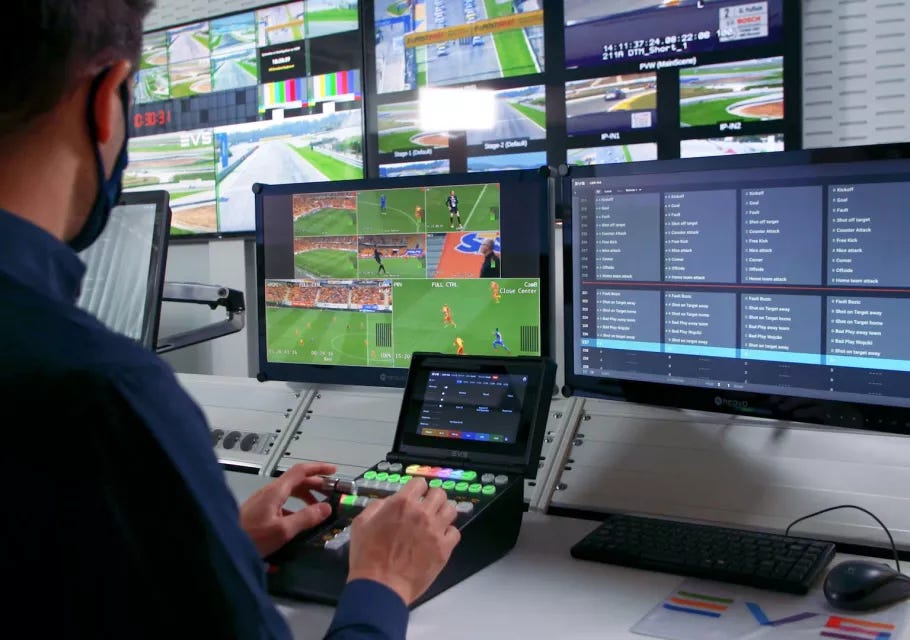
MediaCeption is the central hub for managing video content from recording to delivery. It unifies different production stages, including bringing in video (ingest), organising, editing and distributing it for news and sports.
The technology connects live production with archives and social media publishing. Production teams can work faster thanks to AI deployment for tasks like video archive search, speecht-to-text conversion and object recognition.
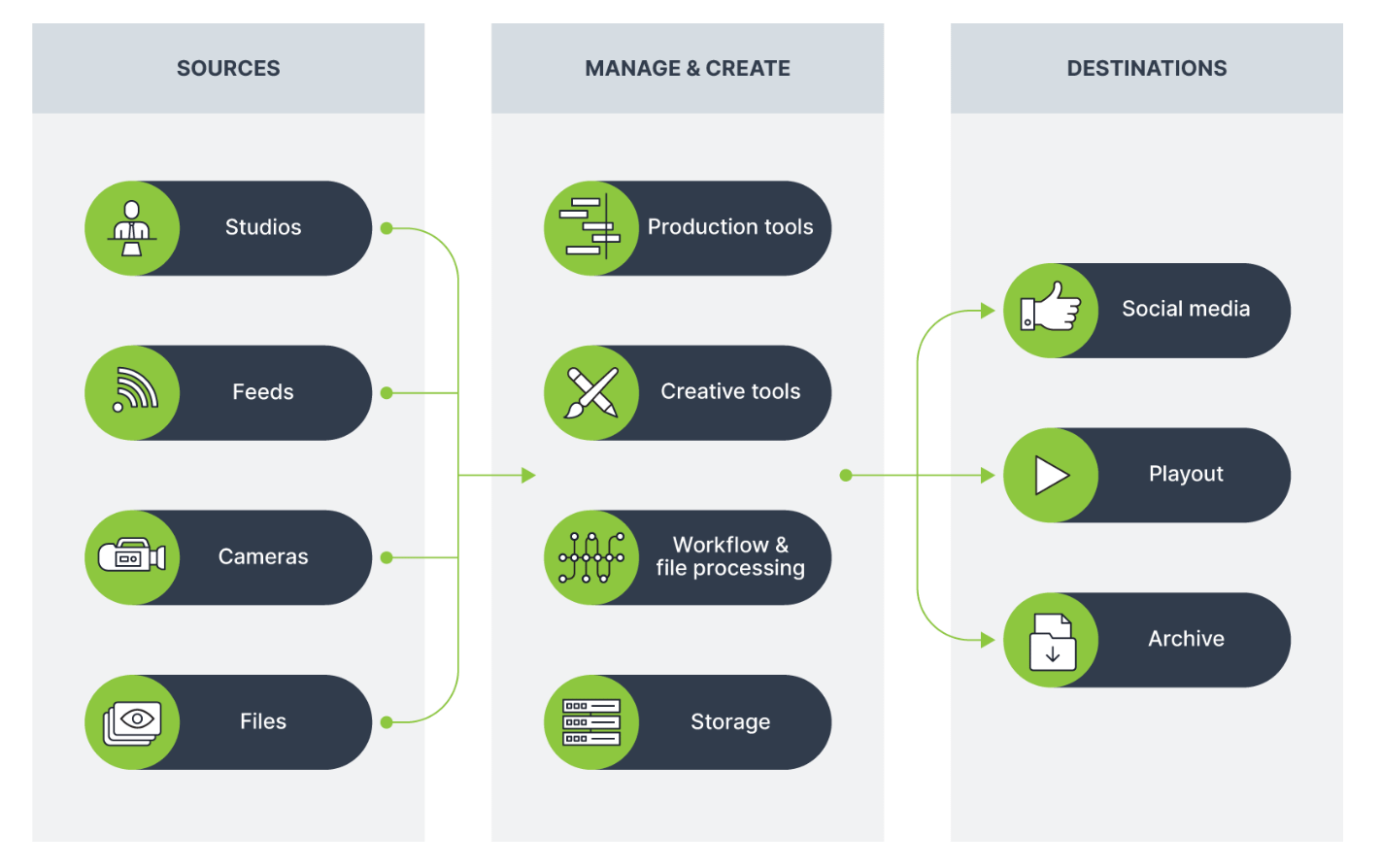
Media Infrastructure provides the underlying "brain" and technical foundation that routes and processes video signals within a broadcast facility. Its primary goal is to ensure that video and audio signals get where they need to go reliably, whether the facility uses traditional cables or modern computer networks.
I can’t really explain this without taking up too much space, so I thought this video might be helpful instead:
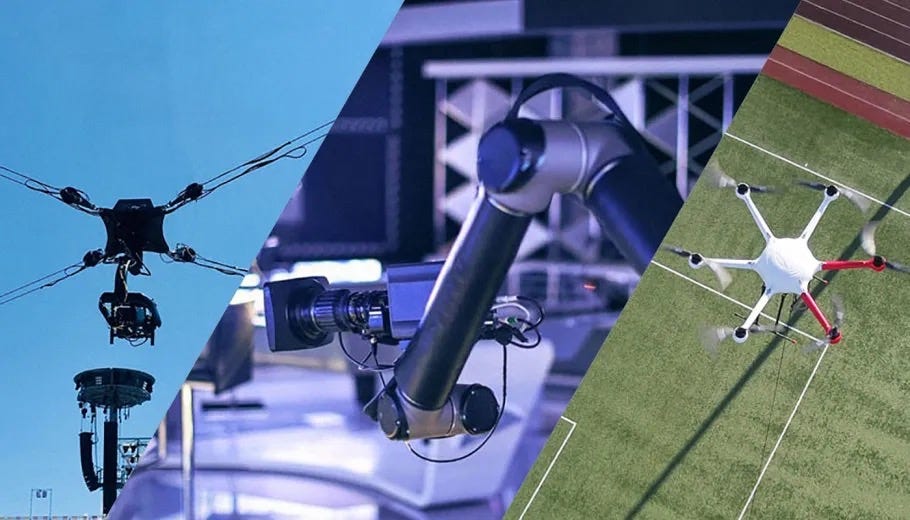
T-Motion is the newest division at EVS, created in 2025 to provide robotic systems for cameras. By combining the expertise of the recently acquired companies Telemetrics and XD Motion, this unit offers automated camera movements.
These robotic systems use AI to help operators with smart movements and automated presets, making production more efficient and creative.
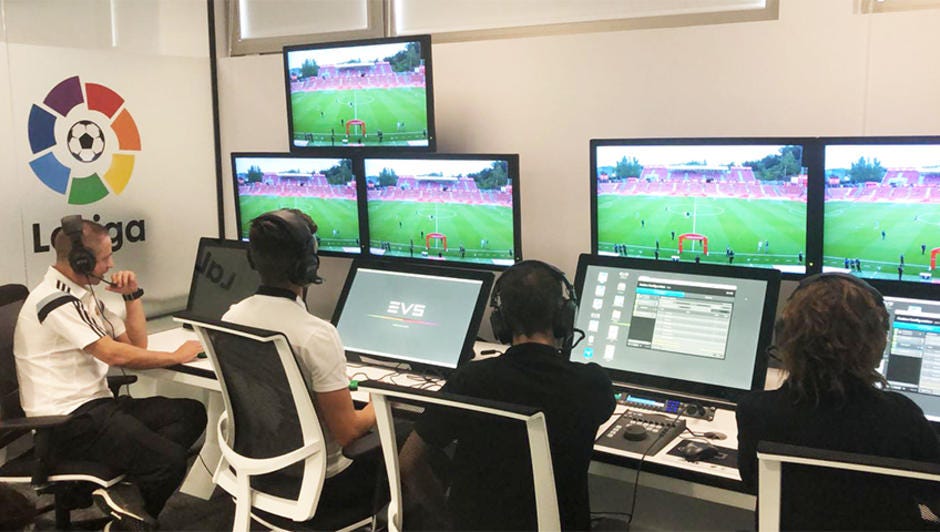
PowerVision the Xeebra Solution lives here. Doesn’t sound familiar? Well, that’s basically the VAR (Video Assistent Referee) you see at work during football games.
Flexible Control Room is a specialised solution called Tactiq, a software-defined interface that unifies video, audio graphics, and lighting control into a single station.
It’s a lot to take in but EVS is basically running an end-to-end shop for the sports broadcasting business, focusing both on products that amplify the viewer value, but also simplify work for production teams. A win-win, I guess?
Revenues follow the cadence of events
There is one important dynamic to understand around revenue generation. Large sport events tend to line up in “even” years, and that brings in additional revenue for EVS, in the range of €14-15 million, and are market as “Big Event Rental”. For 2025, an “uneven” year, EVS generated €208 million, growing by 5.1% YoY.
EVS breaks down revenues into two categories. Equipment sales, covering both hardware and software solutions, remains the dominant revenue stream for the company. In 2025, it accounted for €175 million (84%).
Other services form a significant and growing category, generating €33 million in 2025, and includes professional support services like equipment installations, project management, and training for operators.
Coming back on the Big Event Rental component: this obviously leads to a volatile result profile. To counter this, EVS is trying to double down on Service Level Agreements. These are now accounting for 16.7% of total revenues, and grew 37% over the last two years.
Customer dependency risk is low and loyalty high
EVS categorises its client base into three segments: the Live Audience Business, Live Service Providers, and Big Event Rental.
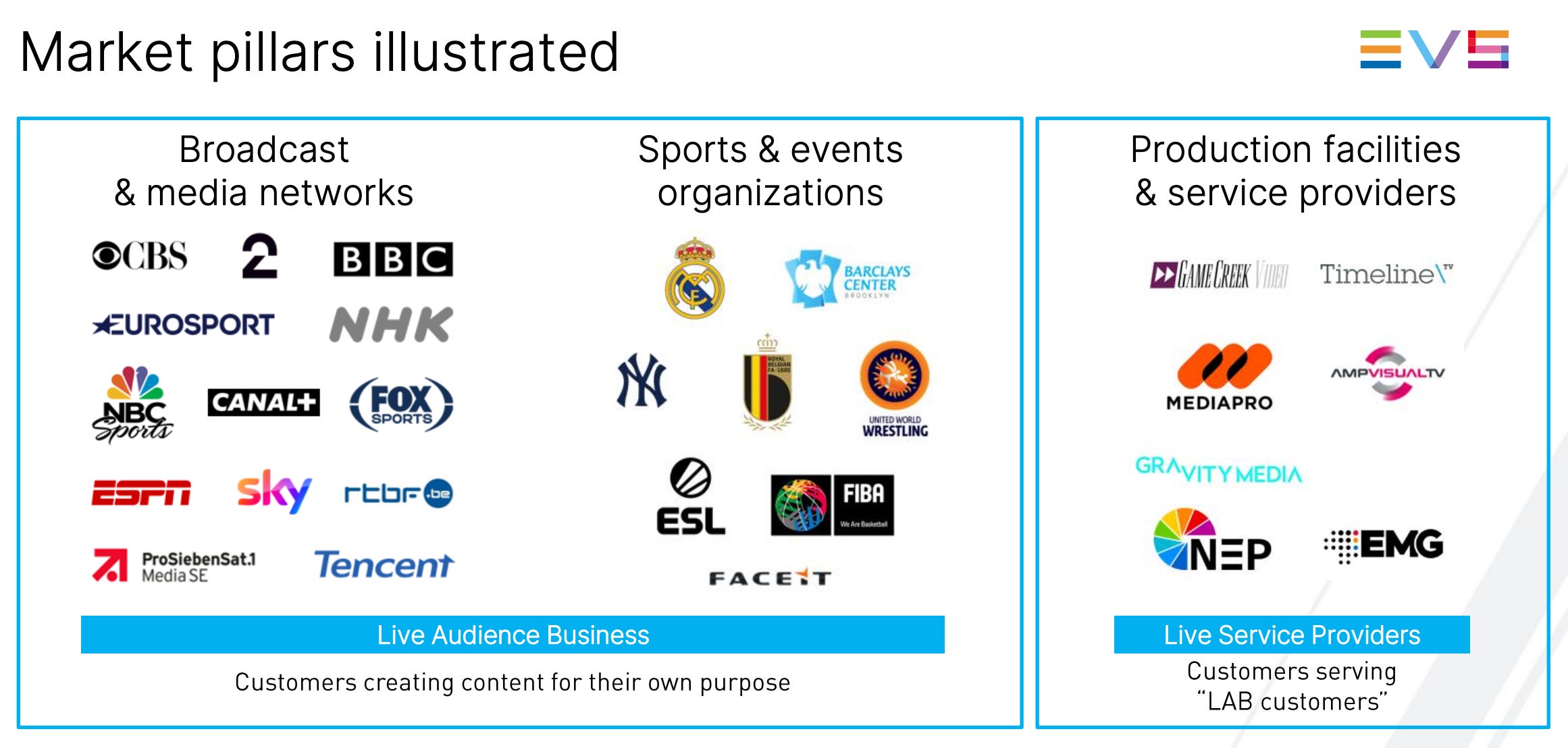
The Live Audience Business, accounting for 59% of 2025 revenues, include organisations that create content for their own use, including major broadcasters like NBC, Fox Sports, and ESPN, as well as stadiums, corporate media centers, and governmental or educational institutions.
Live Service Providers, accounting for 41% of 2025 revenues, include rental and facilities companies, production firms, and freelance operators who leverage EVS tech to provide services to other broadcasters.
As mentioned, large sports events take place in “even” years, so last year the third segment, Big Event Rental, did not generate much. This segment includes host broadcasters responsible for producing events like the Olympics or World Cup.
There is a low customer concentration risk as no single customer represented more than 10% of revenues in both 2024 and 2025. Customer loyalty seems high (if there’s a measure?) as the top 100 clients typically invest in 8 out of 10 years.
M&A and the Big Hairy Audacious Goal
I’m not making this up. That’s actually the name of the revenue target they set themselves (€350 million in 2030). Management estimates that €300 million is feasible organically, which leaves a gap to bridge through M&A.
EVS has built an M&A track record in the meanwhile through the addition of Telemetrics (indoor robotics) and XD Motion (outdoor robotics) in 2025, and MOG Technologies (MediaCeption enhancement) in 2024.
The listed acquisitions were accretive to both revenues and net profit straight away, indicating that management is making the right choices.
Conclusion: Pass ✓
EVS built a comprehensive portfolio of value adding services to the broadcasting production industry. Their M&A strategy seems spot on, enhancing existing solutions, and expanding the portfolio in a meaningful way.
I do not like the dependency on mega-events like the Olympics and the World Cup. They make sales very lumpy, and the risk of missing out on such a reference event might have repercussions in other years when selling to more regular customers.
2. Balance sheet and cash flow
Cash at hand and no debt
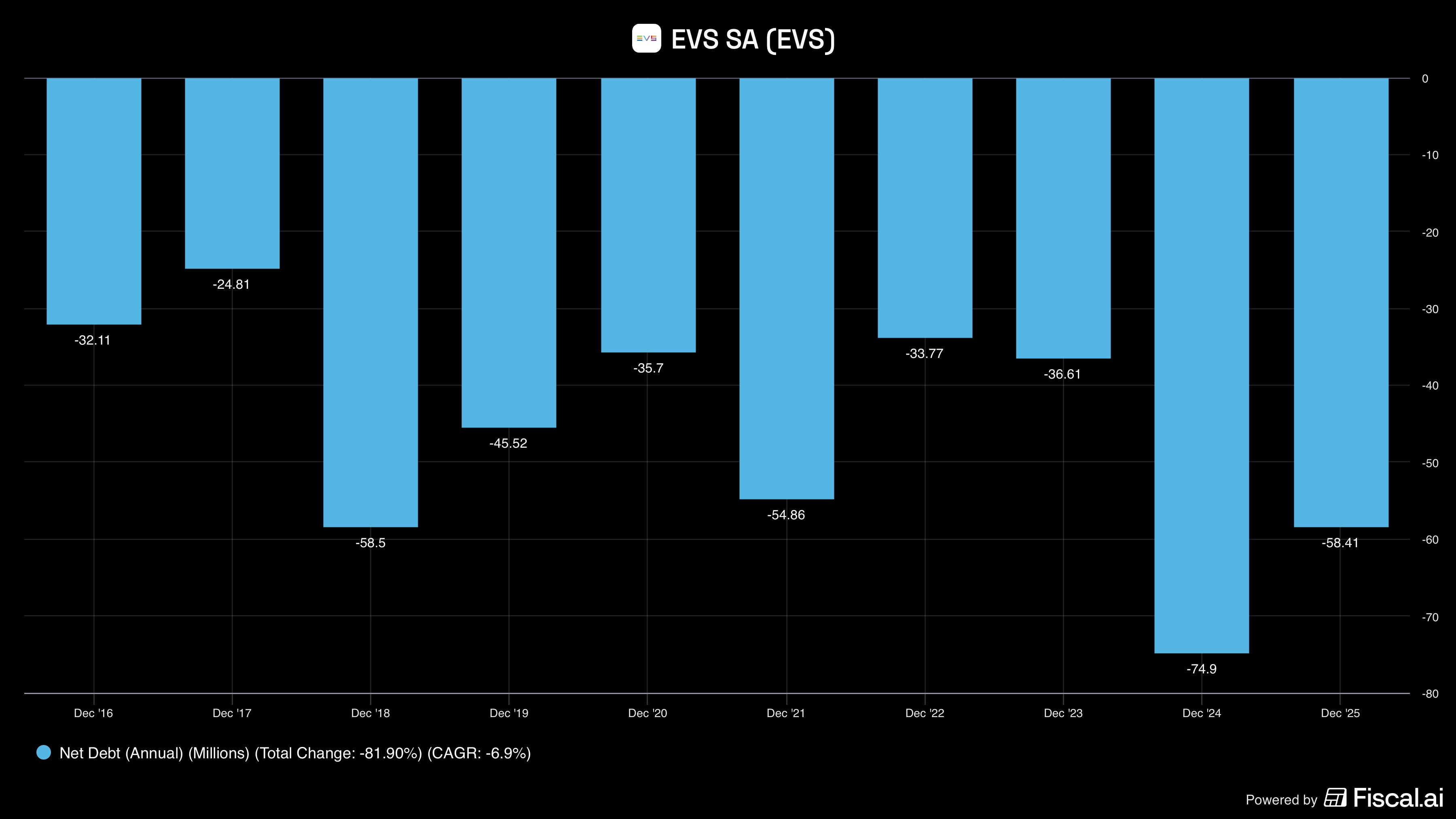
EVS has optionality because it sports a net cash position of €58 million and no debt to pay back. It is a decline from the €75 million in 2024, but that’s due to the acquisitions mentioned earlier, a €10 million share buyback program and a 3.4% dividend yield.
FCF is all over the place due to macro factors and internal screw ups
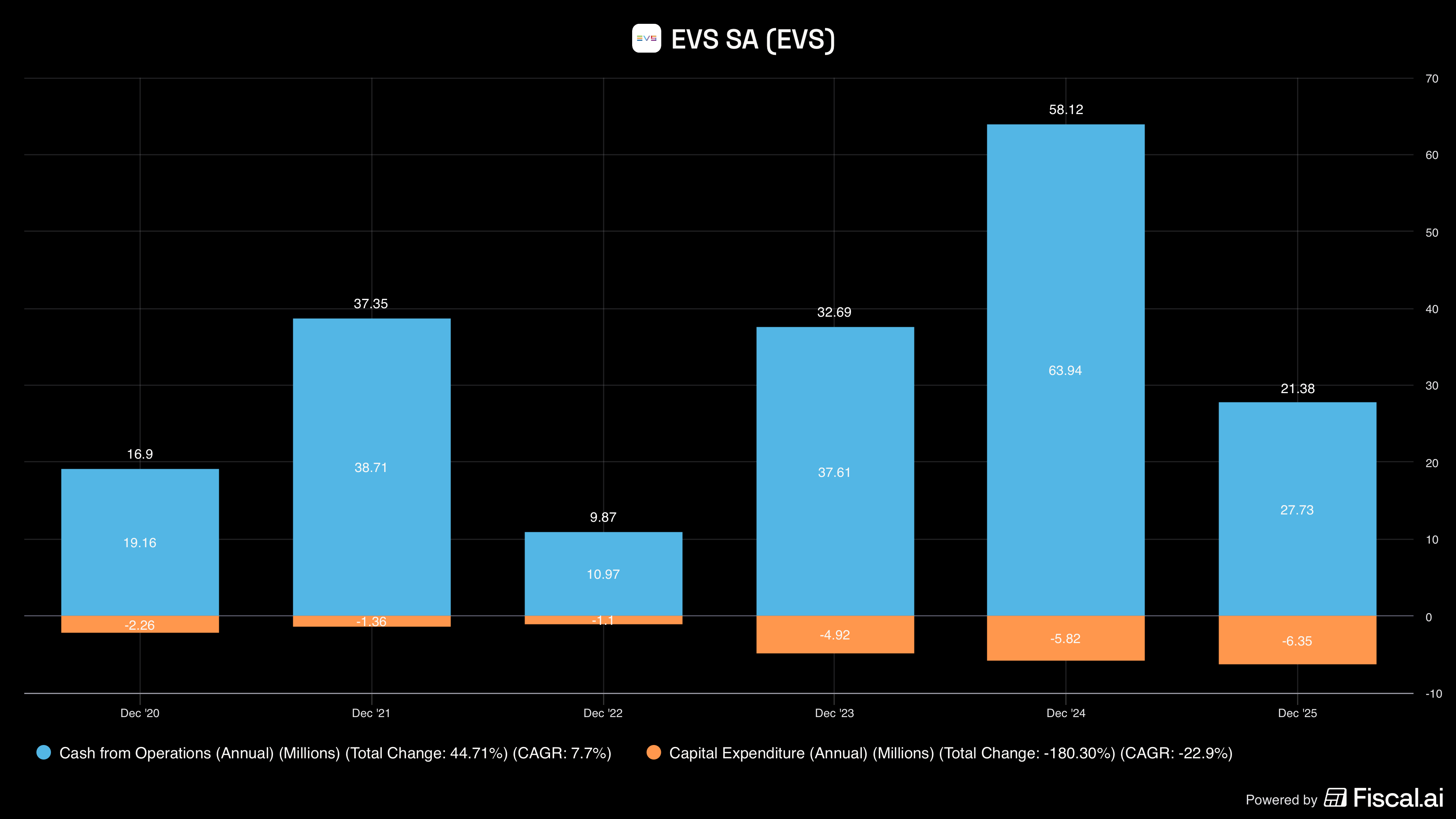
It’s not a pretty sight, but let me explain. The swings in operating cash flow were driven almost entirely by working capital timing, and IT issues, rather than a deterioration in the underlying operating business.
I think no explanation is needed for the fluctuation in 2020 and 2021 (pandemic). However, in 2022, an ERP transition delayed Q4 invoicing. In 2023, that ERP effect reversed, bringing FCF back up. And in 2024, a structural improvement in receivables collection combined with record profit pushed FCF to a new high.
Cash from operations fell to €28 million in 2025, mainly due to a €23 million rise in trade receivables driven by strong but unpaid December revenue and newly acquired T-Motion receivables. A weaker US dollar added further pressure.
EVS is not a capital intense business
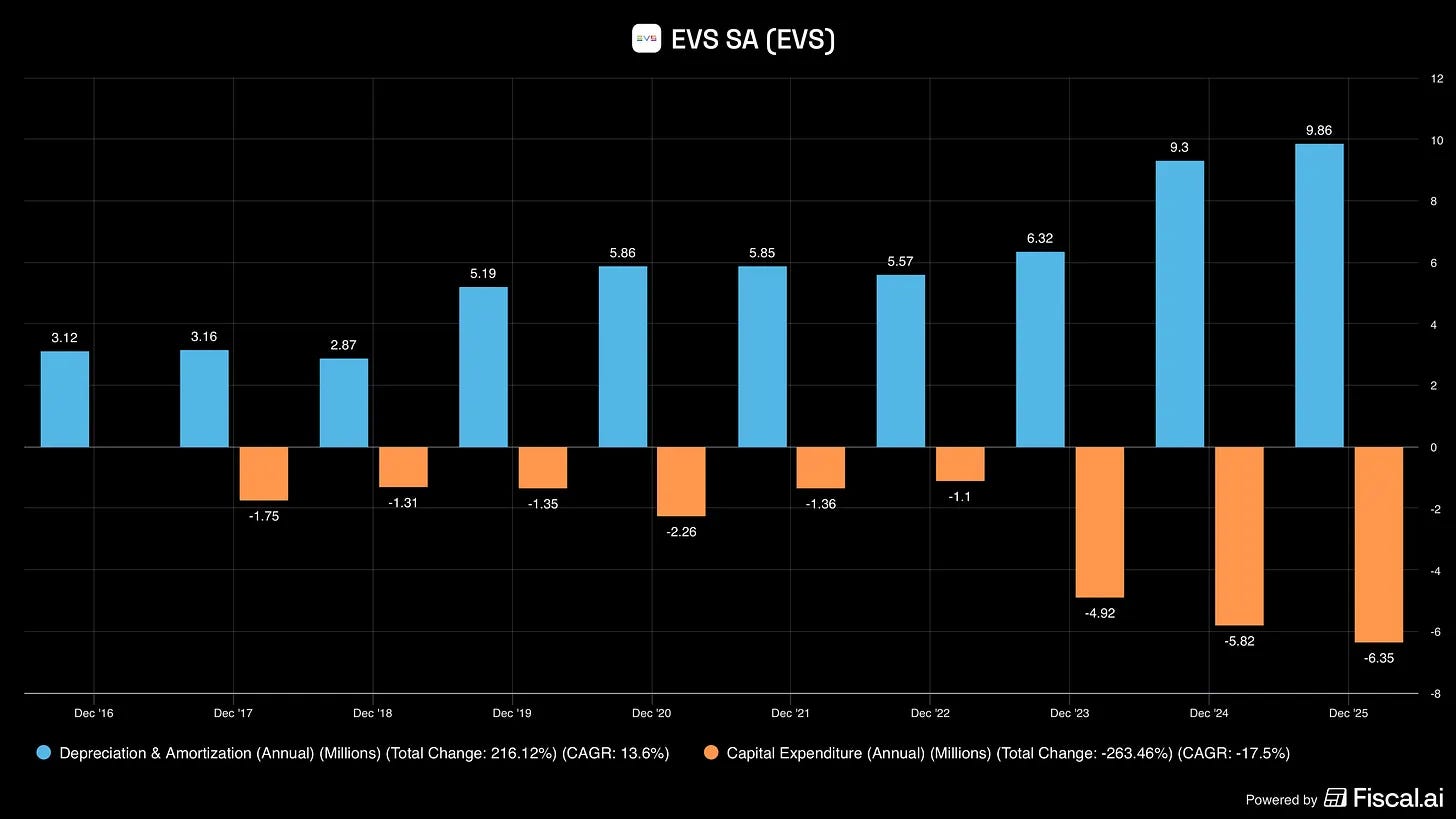
The visual from Fiscal.ai is a bit misleading, but you get the point. It shows D&A and CapEx between 2016 and 2025.
D&A is slowly rising due to the amortization of acquired technology and customer-related intangible assets. But, nothing to worry about in my opinion.
CapEx, which we see as fuelling growth, came in at approx. 4.1% of sales in 2025, a sensible level driven by capitalised R&D and growth-related investments.
Conclusion: Pass ✓
The balance sheet should give comfort as there is cash available and no debt. I’m not in love with their volatile FCF profile. The reasons are always operational, and it seems there have been some misfires in the past.
EVS is - to my surprise - not that capital intense. I do expect CapEx to intensify in coming years as the companies aims to meet its 2030 goals.
3. Profitability
Healthy gross and net profit margins pressured by acquisitions
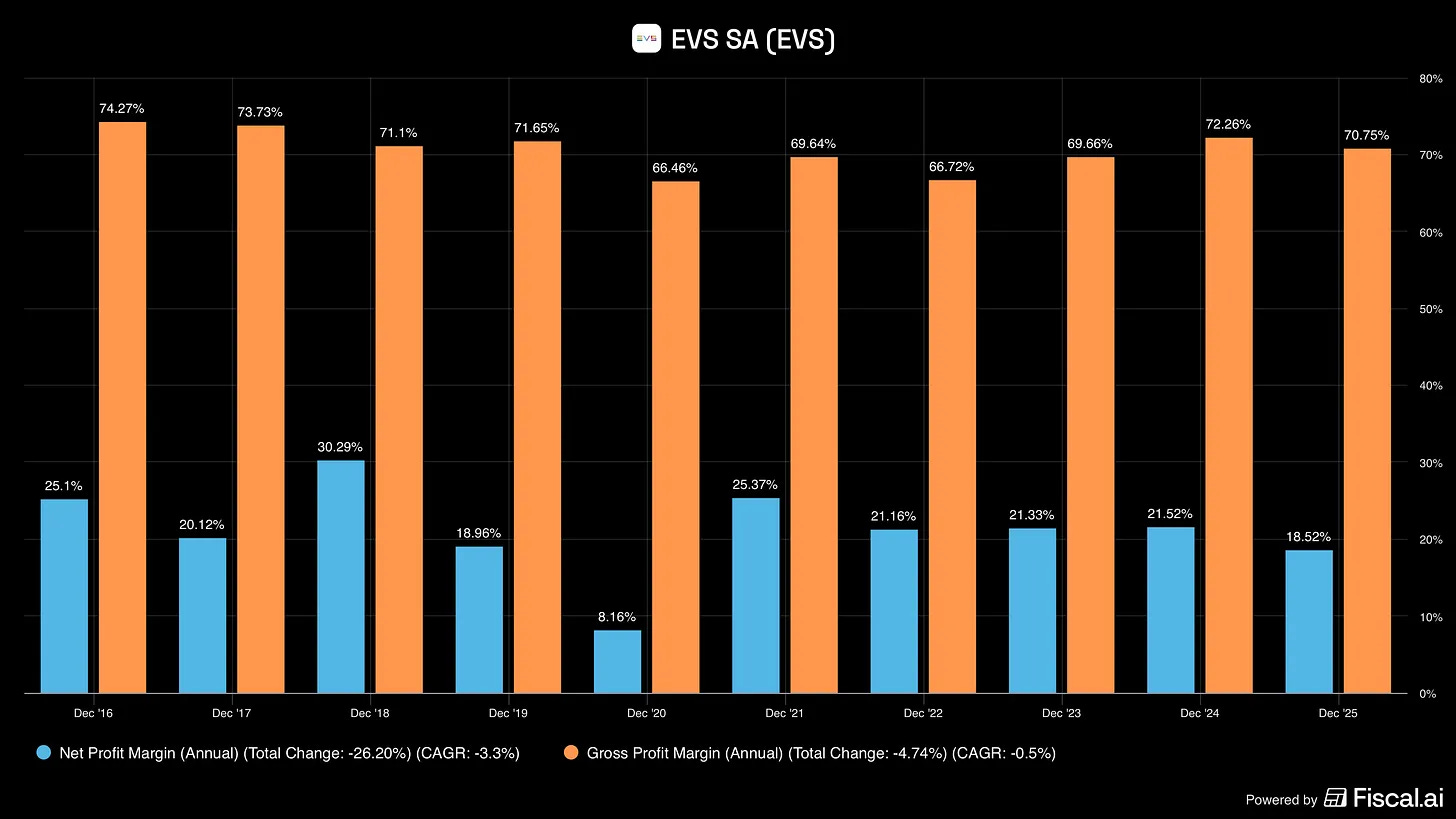
In 2025, EVS’s gross margin decreased to 70.8% from 72.3% in the previous year, primarily as a result of the dilutive effect of integrating the new T-Motion robotics business and the impact of US tariffs.
What I found interesting is that the company also signed a single large strategic deal that carried higher-than-typical discount rates. The CFO however flagged that there is no sign of broad-based discounts being handed out.
The net profit margin also declined, falling from 21.5% in 2024 to 18.5% in 2025. This was driven by a deliberate 7.0% increase in operating expenses to support the “Double Down North America” strategy and accelerated R&D initiatives, alongside the absence of high-margin Big Event Rental revenue in an “uneven” year.
Healthy returns on investment
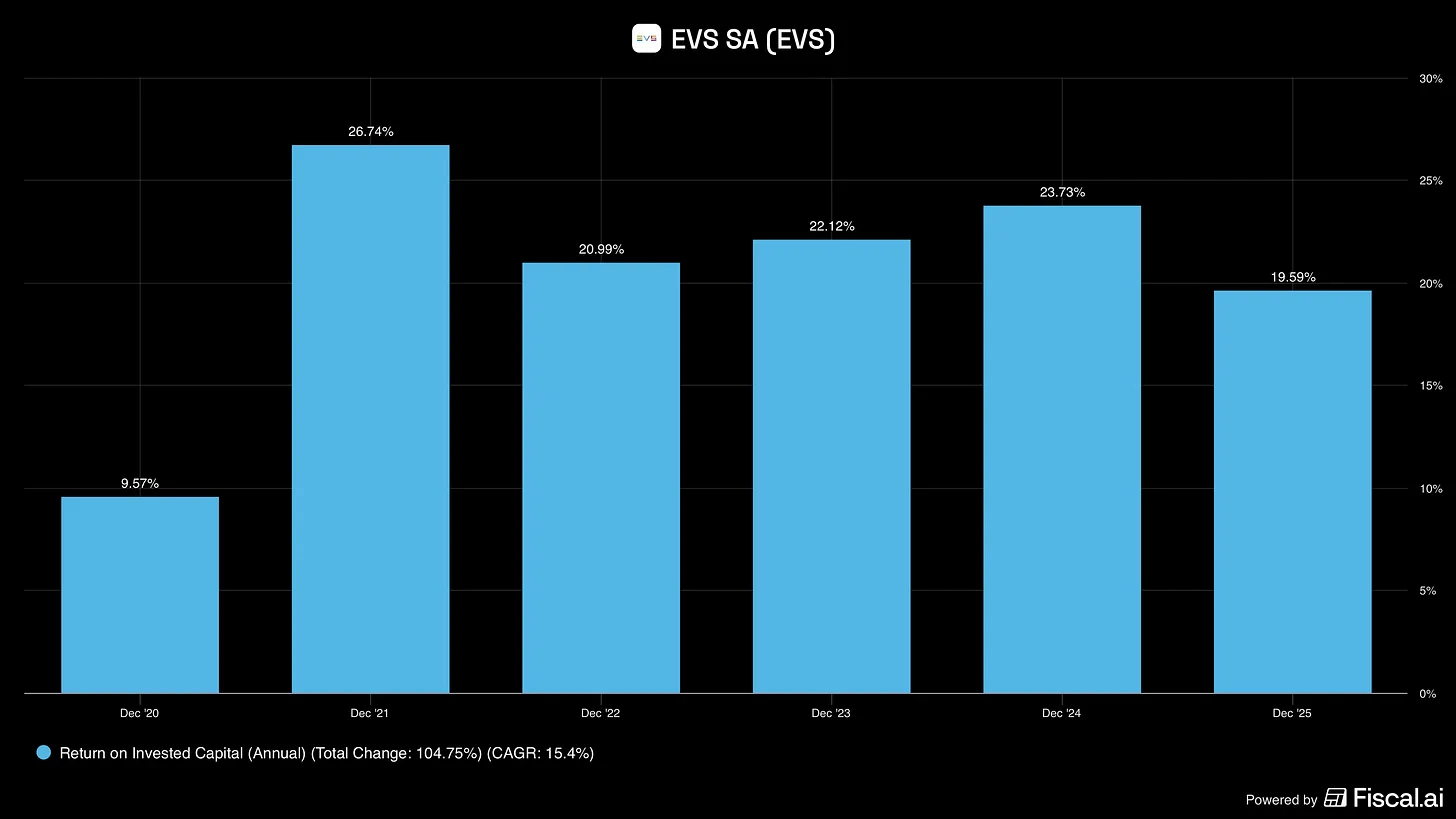
Return on Invested Capital is critical because it assesses the company’s profitability and capital efficiency.
EVS returns have been very healthy. The main reason for the slight decline was due to the acquisitions that took place. I’ve mentioned this earlier on. The acquisitions sported lower margins. The CEO emphasised they are working on improving these.
Minimal dilution through SBC and share issuance
Total diluted shares outstanding increased 3.2% between 2020 and 2025. Today, Stock-based compensation totals €1.3m. That’s completely reasonable for me. Nothing to see here. Let’s move on.
Conclusion: Pass ✓
EVS is very profitable, although margins slightly decreased over the past years. Integration of acquisitions, as well as dealing with tariffs were the main culprits in previous years. It is positive to read that there is barely any dilution in the shape of SBC or issuing new shares.
4. Competitive advantage
This might actually be the factor that keeps me on the side. Competition is fragmented and the industry as a whole is changing. That forces EVS’s hand to make changes to their portfolio and operations.
Let’s look at competition first. Grass Valley is EVS’s closest competitor and has gotten more aggressive since being bought by Black Dragon Capital in 2021. They compete on a few fronts: a cloud-based system for producing live video remotely, camera-related products, and they offer end-to-end broadcast setups (cameras, switchers, etc.). They also tend to win deals by bundling all of this together at a lower combined price, especially when bidding for big sports contracts.
Evertz Technologies is another strong challenger across broadcast, post-production, and new media, particularly in IP and software-defined video. Other rivals (Merging Technologies, Lawo, Cisco Systems, and Crestron Electronics) compete more on specific segments like audio, IP infrastructure, or control systems, rather than across EVS’s full portfolio.
I think that’s a typical setup: one big competitors, and many smaller and specialised players. But as I mentioned before, it’s not only competitors that are a worry.
There is a shift ongoing in the industry: production is moving toward software-based, cloud workflows, which chips away at EVS’s traditional edge in physical hardware, and lets leaner software-only rivals undercut on price.
On top of that, streaming giants like YouTube, Netflix, and Amazon Prime moving into live sports are pushing broadcasters to expect more flexible, cloud-based setups, even though these platforms aren’t direct EVS competitors.
In response, EVS is buying smaller specialised companies to fill gaps (like camera robotics and orchestration), pushing further into AI and cloud subscription products so it isn’t just selling hardware, and leaning on its reputation for rock-solid, low-latency reliability in big live sports events, where broadcasters still pay a premium.
Conclusion: Caution ⚠
Yes, there is competition, but that’s nothing to really worry about. The bigger issue is a broader industry shift where EVS was forced to adjust its portfolio and acquire smaller and more specialised companies. That all comes with an execution risk. If they miss, EVS risks being left behind.
5. Management
Serge Van Herck has led EVS as CEO since September 2019, bringing more than 30 years of experience in the broadcast and satellite industry.
Credit where it is due: under his leadership and the company’s PLAYForward strategy, revenue has grown from €103 million in 2019 to €208.1 million in 2025.
On ownership, insider holdings totalled 784,000 shares, or 5.5% of the company’s capital. The vast majority of this stake belongs to Michel Counson, Managing Director and co-founder, who alone holds 781,500 shares.
Most of the Executive Management team also hold shares, but their individual stakes generally fall below the 3% mandatory disclosure threshold and aren’t rolled up into the Board’s aggregate figure.
One notable setback for management is the departure of CFO Veerle De Wit, after nearly five years in her role. This is viewed as a significant loss and does not calm down the markets.
Conclusion: Caution ⚠
Mr. Van Herck has a proven track record at EVS. It’s hard to argue there. But, insider ownership is relatively low, and the loss of Veerle De Wit as CFO is not a good look.
6. Outlook
According to EVS’s own data, the broadcast equipment market only grows 2 to 3% annually. This is not something we can label as “very attractive”. It also falls short of the 8% organic growth required for EVS to meet its targets.
So now we have to see whether EVS can actually get to this 8% growth, as part of their business plan for 2030.
A fundamental pillar of this growth is the company’s structural evolution from a product-led hardware provider into a software-driven, ecosystem-based platform that reduces operational complexity for Tier 1 customers.
This transition is designed to improve the quality of earnings by increasing recurring revenue through the expansion of Service Level Agreements and new subscription-based licensing models like the e-Shop. Geographically, North America serves as the primary engine for this expansion, where EVS expects to achieve a high single-digit annual growth rate by deepening customer intimacy and scaling its local organization.
Furthermore, EVS plans to outpace the traditional broadcast market by aggressively targeting the Live Audience Business (LAB) segment, which includes corporate media, houses of worship, and sports venues.
EVS also highlights that some of its competitors are leaving the live broadcasting market, leaving a vacuum for EVS to fill.
Conclusion: Caution ⚠
I think EVS’s growth outlook is ambitious, and much depends on their ability to execute and win new and significant deals. The gap between the underlying industry growth, and what EVS management sets forward is quite a gap to fill.
7. Valuation
Before we dive into the details its important to know that EVS posted a trading update on May 21st 2026 with guidance, and a little disclaimer:

The list of potential headwinds were not appreciated by the market. EVS management is now aiming for €220-240 million in revenue, and €40-50 million in EBIT.
For the sake of being conservative, let’s use the lower bound of this outlook to decide whether EVS is trading at a cheap valuation or not.
Forward PE
EVS’s average FWD PE between 2021 and 2025 was 10.5x, which is quite low for a company that grew revenues over the same period with a 10.9% CAGR.
Today, EVS sports an 9.8x FWD PE assuming the low bound of their guidance, similar tax rate and 13.4 million shares outstanding. That is considerably lower than the historical average.
But, the company did give a soft guidance warning. And the CFO leaving is never a good sign. The lack of explanation leaves a vacuum for investors to speculate in. So I would not consider this factor. Who knows why she left?
Reverse DCF
I use the following parameters and get to a required cash flow growth of 5.4% to meet a 10% growth expectation:
Current stock price: 26.7
Shares outstanding: 13.4 million
Perpetuity growth rate: 3%
Target return: 10%
FCF year 1: 21.4 million
The required FCF growth going forward is not demanding at all, especially given that FY2025 saw high CapEx of €6.3 million.
Earnings growth
This metric shows you the return we can expect as an investor. Here is the calculation:
Earnings growth = EPS growth + dividend yield + PE multiple (expansion/contraction).
According to the Big Hairy Audacious Goal, EVS wants to grow revenues to €350 million by 2030. This year they will land at €220 million (lower bound guidance). That implies a 12.3% growth rate from here for revenues.
Now let’s assume they only manage €300 million by 2030, and that revenue growth equals EPS growth. That would mean the expected EPS growth rate is 8.1%. Far more conservative, but let’s be cautious.
The current dividend yield is 3.4%, and I do not assume any PE re-rating. That’s a gale I try not to make.
Earnings growth = 8.1% + 3.4% = 11.5%
Conclusion: Caution ⚠
EVS is cheap to fairly valued at the lower bound. The company produces significant amounts of FCF and is expected to generate 11.5% earnings growth.
The company never commanded a premium valuation so there’s no reason to believe a re-rating will ever take place. In addition, I do not see a super clear path towards an 8.1% EPS growth, especially given that acquisitions so far have been compressing margins.
8. Landing the plane
EVS Broadcast Equipment runs a great business. A clear and comprehensive business model, a healthy balance sheet and strong levels of profitability. What else can you wish for?
Unfortunately, I am not 100% convinced about a few things. For one, the expected growth going forward is quite uncertain. They need to push well above their weight to generate interesting returns. Also, the live media and broadcast industry is currently undergoing a “profound and lasting transformation”. It’s more software-based, more cloud-based, becoming global, and AI is playing its part as well. That all forces EVS to adjust, which comes with a serious execution risk.
The valuation is fairly cheap
based on the lower bound of the guidance. It seems the market has already priced in some margin of safety here.
I will add EVS Broadcast Equipment to our shortlist and will likely await the next set of earnings to understand how well the company executes on their strategy.
Sources
Fiscal.ai
EVS Investor Relations resources
Disclaimer: This is not financial advice. Do your own research.